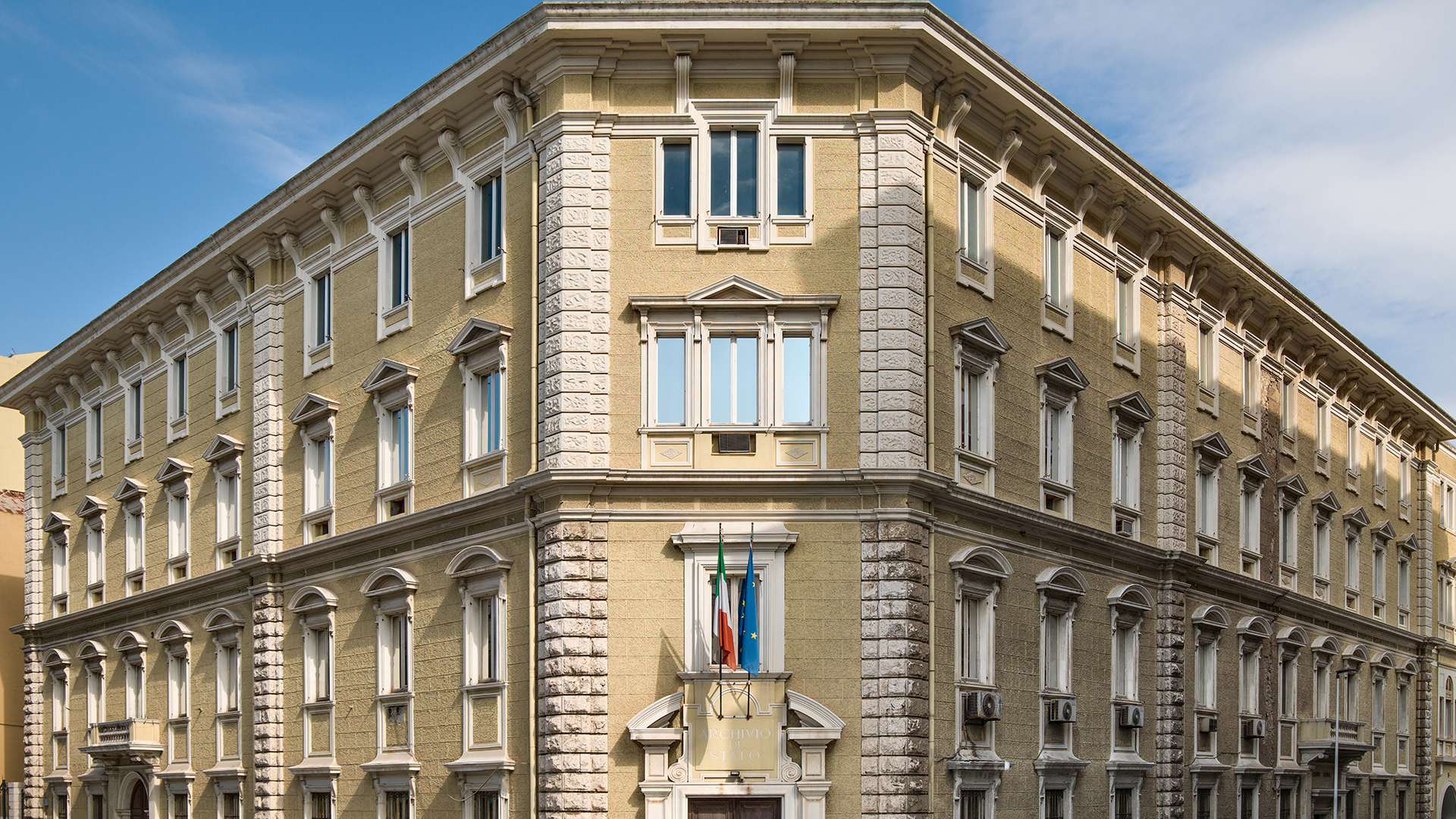
Under the government of Carlo Emanuele III and the minister Bogino, the Archive was reconstituted as the central and general archive of the island. In 1848, with the cessation of the administrative autonomy of the Kingdom of Sardinia, it passed from general to provincial, with the name of Royal Archives. The institute was, with R.D. 5.3.1874, n.1852, placed, like the other Archives of the pre-unification States, under the Ministry of the Interior, becoming to all intents and purposes a State Archive with provincial jurisdiction; since 1975 the State Archives of Cagliari have been a peripheral body of the Ministry of Culture.
The preserved heritage, totaling more than 10,000 linear meters of documentation, covers a chronological span of seven centuries, up to the most recent contemporaneity; the Archive, in this sense, is the most important conservation institute in the region, conserving the most important archival funds relating to the territory; which place of culture is a point of reference for historical research and teaching; It also provides administrative services and hosts a paper restoration laboratory and one of the two-year archival, paleography and diplomatic schools of the Ministry of Culture.
It is housed in a building dating back to the 1920s, a rare example of archival construction from the fascist era: the coexistence, in a single location, of areas intended for storage, use and valorisation involves a considerable commitment to ensure that cultural programming does not divert resources from the pre-eminent protection needs.
Based on this macro need, a project proposal has been defined which, in summary, includes the following interventions:
insulation of vertical opaque surfaces
flat roof insulation
in relation to the areas intended for functional activities of the building (offices, exhibition rooms, libraries, etc.), replacement of the current heating system served by an oil boiler with radiator emission system, with a new hydronic heat pump generation system and fan coil emission system
in relation to the spaces intended for storage, replacement of the current U.T.A. (currently being disposed of) for temperature and humidity control with new U.T.A. with multipurpose heat pump system
renovation of the electrical system and lighting system; BACS system for the control and automation of heating/cooling and lighting systems
installation of a photovoltaic system on the roof and appurtenances
The proposed interventions simultaneously pursue the fundamental objective of increasing efficiency and reducing energy consumption attributable to the system of conservation of documentary heritage and of containing energy consumption for heating and cooling the building in the areas intended for civil activities, as well as the management of all the services of the structure.