
What is Art Bonus?
Art Bonus is a tax credit for cash donations supporting culture and the performing arts, introduced by Article 1 of Decree-Law No. 83 of 31 May 2014, converted with amendments by Law No. 106 of 29 July 2014, as subsequently amended, entitled ‘Urgent provisions for the protection of cultural heritage, the development of culture and the relaunch of tourism’, as a means of supporting patronage for cultural heritage.
Those who make monetary donations in support of culture, as provided for by law, can benefit from significant tax advantages in the form of a tax credit. For further information, click here
For initiatives promoted by the Cagliari State Archives, visit this link.
____________________________________________________________
DONATIONS RECEIVED, YEAR 2025 – ‘Support for institutional activities 2025’ project
| DONOR | AMOUNT (in euro) |
|---|---|
| SIENDHAS S.R.L. A CAPITALE RIDOTTO | 100,00 |
| Private individual | 4,46 |
| TOTAL | 104,46 |
____________________________________________________________
A totem for donations to the Cagliari State Archives: visitors can benefit from Art Bonus
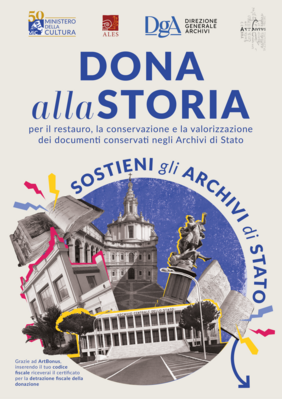
As at 26 other Italian State Archives, users and visitors to the Cagliari State Archives can make donations through a kiosk installed at the entrance while benefiting from theArt bonus, a scheme that grants a tax credit equal to 65% of the amount donated to those who support Italy’s public cultural heritage.
This innovative project, “Donate to history. A kiosk for the Archives” (“Giving to History. A Totem for the Archives”), was strongly promoted by the Directorate‑General for Archives of the Ministry of Culture, in cooperation with Ales Arte Lavoro e Servizi S.p.A., to protect and promote archival institutions.
As is already the case in some cultural institutions and museums that offer free admission, the idea is to promote a specific project through a series of information panels and a donation totem located near the entrance to the Archives. Visitors will be able to make donations by credit card, including amounts as low as Euro 5. Once the donation has been made, the donor automatically receives a receipt for the liberal donation at their email address, which can be used to claim the Art Bonus tax credit.
“The project is designed to combine free access to archives with the need to encourage the collection of micro‑donations from visitors (researchers, conference participants, tourists). This also allows us to make virtuous use of the extraordinary increase in visitor numbers which, in 2024, rose by 39.7% compared with 2023, reaching 109,885 compared with 78,631 the previous year”, said the Director General for Archives, Antonio Tarasco“In recent years – thanks to Art Bonus – many archival protection and promotion projects have been launched thanks to the generous support of numerous culture enthusiasts. Between 2021 and 2024, for example, around 1.4 million euros were raised for Italian archival institutions, enabling major restoration and digitisation projects. They also supported the promotion and dissemination of documentary heritage through the publication of volumes, the reorganisation, optimisation and expansion of finding aids, and the cataloguing of numerous collections. The totems are an additional, innovative and digital resource for all citizens who wish to contribute, even with small donations, to safeguarding and rediscovering Italy’s archival holdings.”
“I would like to congratulate Director Tarasco on his vision and this excellent initiative. We at Ales see it as a way of bringing patronage even closer to Art Bonus, a tool that has now become indispensable. In exactly ten years, we have raised over one billion euros in private contributions in support of Italy’s cultural heritage”, noted Chairman and CEO of Ales, Fabio Taglieferri.
The archives were selected so as to include at least one per region and, in some cases, two per region, on the basis of visitor numbers and the importance of the historic site. Totems are available at the following institutions: Piedmont (Turin), Lombardy (Milan and Brescia), Veneto (Venice), Friuli‑Venezia Giulia (Trieste), Liguria (Genoa), Emilia‑Romagna (Bologna and Modena), Tuscany (Florence, Siena and Pisa), Marche (Ancona), Umbria (Perugia), Abruzzo (Pescara), Molise (Campobasso), Lazio (Rome and Central State Archives), Campania (Naples and Salerno), Apulia (Bari and Lecce), Basilicata (Potenza), Calabria (Reggio Calabria and Cosenza), Sicily (Palermo), Sardinia (Cagliari), Trentino‑Alto Adige (Trento).
If the response is positive, the initiative may be extended in the coming years to other sites as well.