
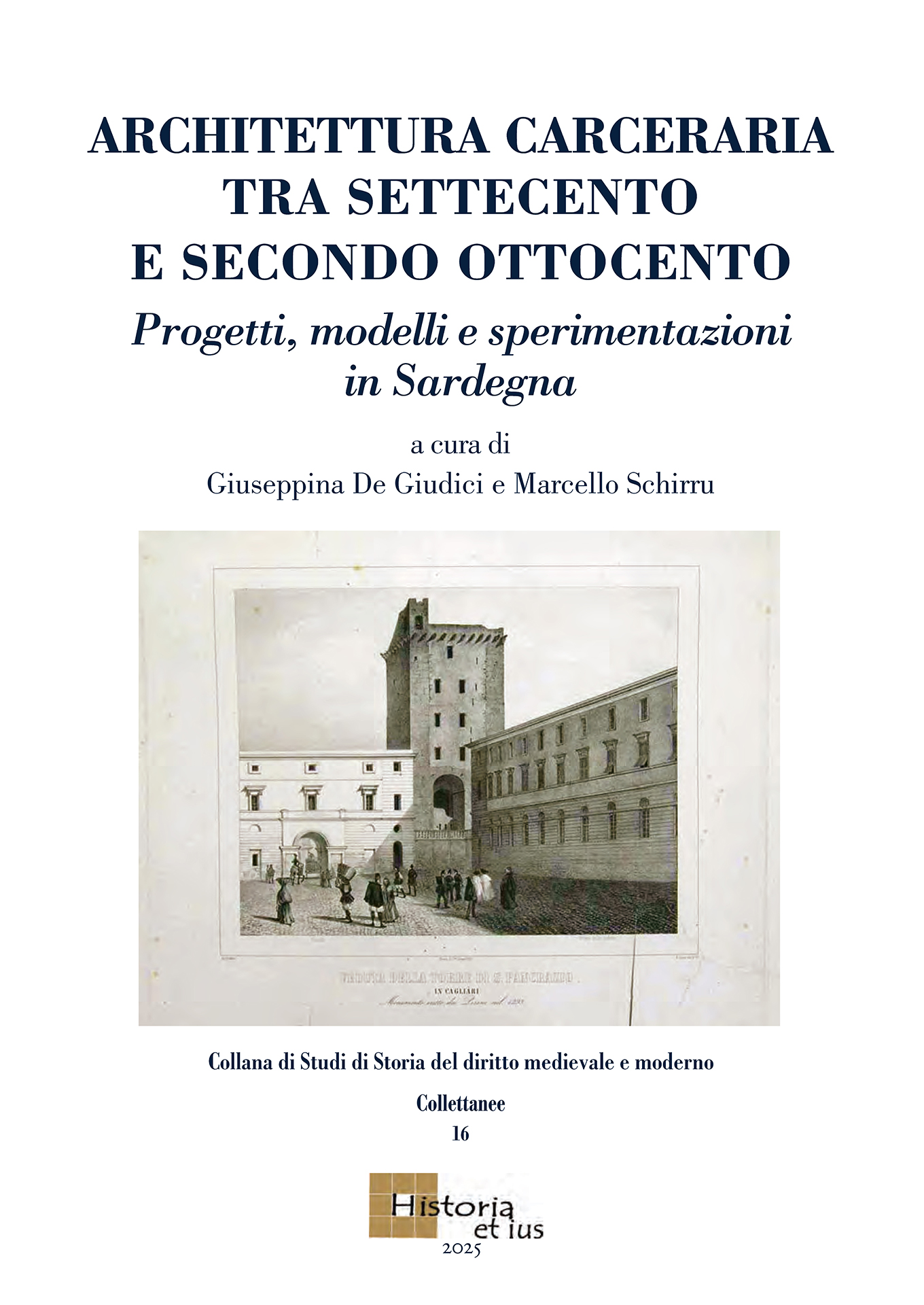
The volume, offering a multidisciplinary approach that interweaves history of architecture, penitentiary law and sociology, analyzes the transformation of prison architecture in Sardinia between the 18th and 19th centuries, documenting the transition from the prisons of the Ancien Régime to rational models inspired by Enlightenment thought and international systems.
The work highlights how the island has represented a privileged territory for the experimentation of new models and, through the investigation of emblematic cases – such as the circular prisons of Nuoro and Tempio Pausania and the evolution of the Buoncammino penitentiary in Cagliari – investigates the relationship between the architectural history of the prison establishments and the related sociological and historical-legal aspects.
This approach made it possible to reconstruct the inseparable link between detention spaces, judicial reforms and construction techniques, highlighting how the latter, the concrete application of penalties and their compliance with the regulatory frameworks of the time are complementary.
Based on extensive archival research, the publication finally addresses the contemporary challenges of the restoration and urban refunctionalization of disused historic prisons.
Edited by Giuseppina De Giudici and Marcello Schirru, Prison architecture between the eighteenth and second half of the nineteenth century. Projects, models and experiments in Sardinia, 2025, 152 pp., ISBN 979-12-81621-16-9.